Showing posts with label Chemical Facility Safety. Show all posts

Monday, May 28, 2018

CSB Releases Final Report on Arkema Fire


Last week the Chemical Safety Board (CSB) released their final report [.PDF download] on the Arkema chemical facility fire that occurred as a result of the flooding during Hurricane Harvey last year. The detailed report is lengthy and detailed and deserves the attention of safety professionals, but the Executive Summary is surprisingly detailed and should be read by everyone in the chemical industry. And, as usual, the CSB has produced another excellent video providing a good review of the incident. I cannot say enough good things about CSB incident videos.

High Points


I am not going to go into much detail here because I do not want to give anyone an excuse for not reading the report, but there are a couple of things that need to be highlighted.

First, the Arkema facility team did do a good job in analyzing the safety issues and preparing for the storm. While the CSB report does raise some specific questions and identifies some things that could have been done better, the pre-planning and on-site reactive measures that were taken demonstrate that Arkema was proactive and properly reactive regarding this incident.

Second, the police officers that were exposed to smoke from the decomposition fires during this incident were well within the mile and a half evacuation zone established around the plant when the plant lost the ability to cool the organic peroxides. This was due to the fact that the road outside the plant fence was kept open during much of the evacuation because it was one of the few remaining accessible roads in the area. The affected officers were patrolling that road to monitor the potential effects of the Arkema incident on users of that route.

Finally, the flooding levels seen in the area of the plant exceeded the ‘500-year flood’ level. While it appears that Arkema was not aware of what the 100- and 500-year flood levels were for the facility, this does demonstrate the magnitude of the disaster that was the proximate cause of the Arkema incident.

Commentary


The CSB makes the point that all of the protective measure put in place to prevent the organic peroxides from reaching their self-accelerating decomposition temperature (SADT) failed from a common cause; the flooding at the site. They then go on to recommend (Recommendation 2017-08-I-TX-R1) that the Arkema Facility:

“Reduce flood risk to as low as reasonably practicable (ALARP). Ensure that any safeguards for flooding meet independent layer of protection requirements.”

The fact that Arkema was not aware that a significant part of the facility was within the “500-year” flood plain is a point well taken, but it is not clear that before this incident anyone would have considered preparing for a 500-year flood to be a reasonable standard for preparedness.

Having said that, this incident and the whole Harvey flood calls into question the efficacy of the use of historical flood data in predicting future flooding. Sections 12 and 13 of the report deal with the issue of increasing risks related to ‘extreme weather’ events while being very careful to avoid any discussion of climate change. While the CSB is an independent agency not directly responsive to the Trump Administration (Could that have anything to do with the attempts to defund the organization?) it appears that the agency was very careful to avoid getting caught up in that controversy.

Unfortunately, anyone with a modicum of intellectual honesty has to admit that there has been an ongoing increase in the severity of rain events in the southeast (and along the Texas and Louisiana coast in particular) in recent history. And, that increase is significantly outside of the historic norms. While there may be some room for debate as to the cause of this recent change, the fact that the change exists cannot be ignored. The hard part, however, is going to try to determine what the 500-year flood plain is in the current reality.

Now, I suspect that for political reasons, the FEMA flood maps for the area flooded during Hurricane Harvey will not reflect the fact that the areas flooded now represent the defacto 100-year flood plain, but planners, specifically including emergency response planners, will have to accept that as the current reality.

One final note here worthy of consideration by chemical facility planners (and I will be taking this up in more detail in a future blog post) is the fact that the CSB recommendations do not limit themselves to extreme flooding events. In the Executive Summary (though carefully missing from the official recommendations in the report) the CSB also recommends that (pg 8):

“Seismic hazard maps should be evaluated to determine the potential risk of earthquake. Risk of other extreme weather events such as lightning strikes and high wind events should also be considered.”

Saturday, May 5, 2018

Chemplant Fire in Louisiana


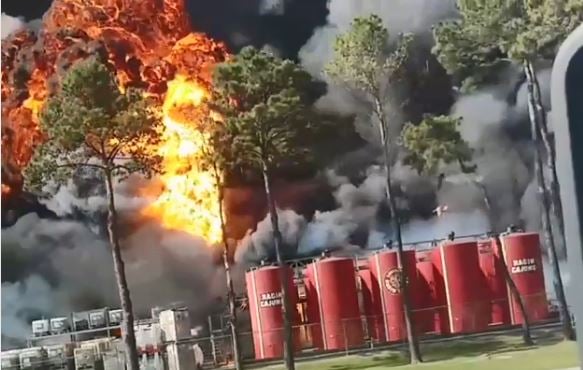
Earlier this week there was a significant fire at a chemical facility in Duson, LA (according to the company web site the location is actually in Rayne, LA, but the news reports are consistent in calling it Duson). The facility appears to be a distribution center for the company’s oil field chemicals, though some blending may take place in at least one of the buildings on site.

The News Reports


News reports (here, here, here, and here) would seem to indicate that the fire started with an initial explosion, followed by a number (one witness reported “dozens of explosions in a half hour to one-hour period”). These reports, combined with a news photo of the incident (which shows the 10 storage tanks on site intact during the active phase of the fire) would indicate that the fire took place in the open storage of chemical containers (55-gal drums, plastic and steel totebins).

A company statement quoted here notes that “there are no uncontained spills”.

Google satellite view shows that a large portion of the facility is given over to open storage of chemical containers. Google street view of that storage area shows that it consists of a concrete pad surrounded by a 6” to 8” curb to contain spills. Street view from the back side of the plant shows that the ‘tank farm’ containing 10 storage tanks (4k-gallons each?) is on the same pad but is surrounded by an additional 8” to 10” curb.

The chemicals reported on site reported include a wide variety of oil field chemicals. Many of these chemicals would have flammability and corrosivity hazards associated with them. A close look at the Street View of the storage tanks shows that at least two of them contained flammable materials. The flammability of the typical oil field chemicals is due to the solvents used, which typically would include xylenes, methanol, toluene and benzenes.

Analysis


The investigation of this fire is ongoing and is being conducted by Louisiana authorities (the CSB typically does not investigate incidents that do not include deaths, wide scale damage, or national news focus). The results of that investigation will not be available for weeks and will probably escape news coverage unless some unusual (read ‘chargeable’) aspects are uncovered.

Based upon news storied I suspect that there was a leak in one of the storage containers on the concrete pad that contained a flammable liquid. Some sort of ignition source (static discharge?) ignited the small pool of spilled chemicals. The initial explosion reported was probably a vapor cloud near the initial fire and probably from the same spill. That small explosion would have damaged nearby containers, contributing to the spread of the fire.

The subsequent reported explosions were probably attributable to nearby containers containing flammable/combustible chemicals being heated to the extent that the gasses expanded in the container until the container was no longer able to contain the pressure. As flammable gasses exited the damaged containers, they were ignited by either the nearby fire or static discharges associated with their release.

At first glance the ‘containment’ at this facility would appear to be rather proforma. The saving grace is that the very large area encompassed by the relatively small curb results in a substantial volume of containment. I have not done the calculations, but it would seem that a large percentage of the containers on site could leak their full contents and the liquid would still be physically contained. Even if one of the storage tanks were to completely drain, it would appear unlikely that any of the contents would flow off site.

This would meet all of the legal standards for containment. The only problem would occur if the leak occurred when there was a large amount of water on site, either due to rainstorms (for which Louisiana is famous) or the application of large amounts of firefighting water. From the news reports that I have seen, it would seem that the local firefighting response did not use large volumes of water; it is usually contraindicated in flammable chemical fires in any case.

The combination of water-soluble (methanol) and water-insoluble (benzene-based chemicals) flammable chemicals on site would cause potential problems with the use of foam for firefighting as they require different types of foam to be used. Still, most fire departments are not going to have access to either type of foam. The best bet in that case is to isolate the facility and stop the fire from moving off-site.

This fire would have been more serious if one of the storage tanks had been a source of the leak that initiated the fire. A fire at the base of one of the tanks could have resulted in a weakening of the tank wall, a resulting collapse and release of the entire contents. The resulting fire and potential vapor cloud explosion would have damaged adjacent tanks spreading the fire throughout the concrete pad area. The overpressure resulting from the larger vapor cloud explosion would also probably have resulted in off-site damage (broken windows and flying debris).

One final note; as is usual with any incident at an industrial facility, at least one news report went back and looked at the regulatory history of the facility involved. They reported on the problems this facility had with the EPA’s hazardous waste regulations. While this is certainly part of the public record, these paperwork violations have little to do with chemical safety and certainly nothing to do with the current incident.

Thursday, August 31, 2017

Harvey Chemplant Explosion – Part I

It looks like this organic peroxide plant situation will be continuing news. It seems that late last night there were two ‘explosions’ at the facility (see here and here for news reports) and a number of police officers are being treated for chemical exposure issues.

NBC News Tweeted® a copy of the Arkema statement about last night’s incident. It makes a very important point: “We want local residents to be aware that product is stored at multiple locations on site, and a threat of additional explosions remains.”

Health Effects


First, we need to remember that the smoke from any fire contains some number of toxic elements and should be avoided. This is especially true when you see thick black smoke; that indicates incomplete combustion and you are going to have a wide variety of chemicals and physical particles that will, at the very least, irritate the lungs.

I am not an industrial health expert, by any stretch of the imagination, but organic peroxides will almost certainly have some level of toxicity due to their chemical nature. The free radicals produced in the initial decomposition are very reactive and will almost certainly react with body tissues. Fortunately, they also react very quickly with oxygen in the air, so this toxicity is typically greatly decreased the further you get from the un-decomposed organic peroxide.

Police officers are always going to be at risk from smoke inhalation injuries due to the nature of their duties since they do not have ready access to necessary personal protective equipment. The standard issue protective mask (used mainly for riot control situations where tear gas may be employed) may not be effective protection against all components of the smoke of an industrial fire. This is why fire fighters carry the heavy and awkward breathing air tanks on their backs.

For more information on the toxicity of organic peroxides you can visit the Arkema web site and find the Safety Data Sheets for the Luperox® line of organic peroxides. I am not sure which of those are manufactured at this particular facility (the local fire department has that list), but you can get an idea of the types of solvents used and the general toxicity information.

SADT


Those SDS also contain another interesting bit of information, the temperature at which a self-accelerating decomposition reaction (SADR) begins {referred to as the self-accelerating decomposition temperature (SADT)}. This is the decomposition reaction that I described in last night’s blog post. This is the critical temperature that I talked about. Looking at a random selection of the Luperox products this morning, it would seem that most have a SADT in excess of 100° F.

Unfortunately, even below the SADT some level of decomposition remains, and the exothermic nature of that decomposition reaction will raise the temperature of the mixture. The SADT is the point of no return. When it reaches the SADT there is essentially nothing that can be done to prevent catastrophic decomposition rates.

The higher the SADT, the longer it is going to take for those containers to reach their failure point, prolonging the current problem. Of course, a fire on the site will change all of that as it would quickly raise the temperature well above the SADT point while weakening the structure integrity of the storage containers.

Storage Issues


One last item that needs to be taken into consideration. Organic peroxides are normally shipped in five-gallon plastic containers. I would expect that this facility would store those on pallets with the containers stacked two or three high. The containers at the center of the stack are going to generally be the first to fail as they are insulated from the cooling effects of the air surrounding the stack.

It would not be unusual to expect that, depending on how the pallets are stacked in relation to each other, that we could see several small ‘explosions’ of individual containers before the bulk of a certain product releases. This could also cause a relatively small fire in the storage area that could expedite other products reaching their SADT.


It will be interesting to see how much detail is included in the monitoring of these storage areas. We could get some very important data on failure rates and effects that could be beneficial in preventing future incidents at these types of facilities.

Sunday, October 30, 2016

Chemical Mixing Incident

Earlier this week the Chemical Safety Board (CSB) announced that it was sending an investigation team to the site of a major chemical release in Atchison, KS that occurred on October 21st. The release was caused by the inadvertent mixing of two common industrial chemicals and resulted in a large chemical cloud sending hundreds to local hospitals with complaints of difficulty breathing.

The Incident


According to news reports (for example see here, here and here) the incident started at 8:00 am when a bulk chemical delivery was put into the wrong storage tank. The two chemicals involved were industrial strength bleach and sulfuric acid, both apparently being used in the facilities waste treatment plant. The chemical reaction between the two produced a large cloud of steam that also included chlorine gas, a byproduct of the reaction between the two chemicals.

There is no publicly available information about which chemical was being unloaded, but due to the odor of chlorine bleach being involved, I would guess that the delivery was sulfuric acid. Adding sulfuric acid to a bleach tank actually produces two separate reactions that would have contributed to the cloud.

First, since bleach is mainly water (only 6 to 12% sodium hypochlorite) the addition of sulfuric acid (which is typically shipped and stored at concentrations above 95% for safety reasons) produced a large amount of heat due to the ‘heat of dilution’. That heat and the lack of mixing would quickly raise the surface temperature of the bleach above the boiling point of water producing a large steam cloud. That steam cloud would be expected to contain trace amounts of unreacted bleach and sulfuric acid.

The chemical reaction between sodium hypochlorite and sulfuric acid produces chlorine gas and even more heat. The reaction is virtually instantaneous and consumes essentially all of which ever chemical is least available (typically the chemical being added to the tank because addition is usually stopped as soon as the steam cloud is observed). That is why I suspect that the sulfuric acid was being added to the bleach tank.

How Could This Happen?


This type of accident is way too common, especially at waste water treatment facilities. Such facilities typically rely on delivery drivers to unload bulk chemical shipments instead of facility personnel who would be more familiar with which tank contains which chemical. Hose connections are made from the delivery truck to piping that leads to the chemical storage tank. A single bulk truck unloading station typically has separate connections for each of the storage tanks at these facilities. Inadequate marking of the pipe connections, and/or inexperienced (for that facility) drivers results in the truck being hooked up to the wrong piping connection.

Larger chemical facilities avoid these types of incidents through a combination of personnel and design activities vetted through a chemical safety program under either the EPA’s Risk Management Program (RMP) and/or OSHA’s Process Safety Management (PSM) program. Typically, there are only a limited number of personnel on-site who are authorized to unload bulk deliveries of chemicals. They are specifically trained on the hazards associated with the bulk chemicals they will be handling, including the risks associated with mixing of chemicals in storage tanks, bulk unloading lines or hoses. Non-facility delivery drivers are never allowed to unload bulk chemicals without specific facility supervision.

Where there is a specific hazard from the mixing of chemicals being stored at that site (for example bleach and sulfuric acid) engineering measures are taken to prevent that mixing. The tanks may be located in separate tank farms, the bulk unloading lines may be physically separated at different unloading stations, or different types of hose connections are used with the unloading lines to make it more difficult to inadvertently mix those chemicals. Depending on the potential consequences involved (and this particular incident was nowhere near a worst-case incident) combinations of these and other engineering controls could be used.

The CSB Investigation


The CSB usually limits its investigations to larger more severe events that kill people or result in large scale damage. This is mainly due to their Congressional mandate, limited funds and limited personnel. Taking up this incident is almost certainly due to the amount of level of publicity related to the large cloud and how common this type of incident is.


Compared to other investigations this one should consume much less in the way of CSB resources. That does not mean that the report will be completed and published any sooner; the CSB will likely place a low priority on the completion of this investigation.

Monday, May 2, 2016

RMP NPRM: Emergency Response Exercises

This is part of a continuing series of blog posts about the EPA’s recently published notice of proposed rulemaking (NPRM) for revisions of their Risk Management Program. Earlier posts in this series include:


Background – Emergency Response Exercises


The current RMP rules do not include any requirements for the conduct of emergency response exercises. The preamble to this NPRM notes that the original RMP NPRM (58 FR 54190, 10-20-93; not available on-line) did include such a requirement, but that it was dropped from the final rule. The preamble notes two reasons for that removal:

“First, the Agency decided to limit the emergency response program requirements to the minimum requirements contained in CAA section 112(r)(7) in order to avoid inconsistency with other emergency response planning regulations. Second, the Agency indicated that the additional requirements were already addressed in other Federal regulations and therefore, sources were already doing them.”

The preamble includes a lengthy discussion about the reasons for having an effective exercise program. The EPA then concludes that:

“However, EPA's experience with implementing the RMP rule over nearly two decades, along with incidents such as those described above, indicate that many regulated sources do not regularly conduct emergency exercises that involve local response authorities. The Agency now believes that adding this provision to the regulation will likely reduce the severity of some accidents that do occur.”

Exercise Requirement


The NPRM would add a new 40 CFR 68.96 outlining the exercise requirements for Program 2 and Program 3 facilities. Two general types of exercises are addressed; notification exercises and emergency response exercises. Both responding and non-responding facilities would be required to conduct notification exercises; while only responding facilities would be required to conduct the emergency response exercises.

Notification Exercises


Section 68.96(a) would require all Program 2 and Program 3 facilities to conduct an annual notification exercise. The notification exercise “would include contacting the Federal, Tribal, state, and local public emergency response authorities, and other external responders that would respond to accidental releases at the source”. Responding facilities would be able to include their notification exercise in their emergency response exercise.

Notification exercises would be documented and those records would be required to be maintained for five years. Those records would be submitted to local officials {§68.205(b)(6)} and be made available to the public {§68.210(b)(5)}.

Emergency Response Exercises


The NPRM would require responding facilities to conduct two different types of emergency response exercises: table top exercises and field exercises. Table top exercises would be conducted every year (except years when a field exercise is conducted) and field exercises would be conducted every five years.

Facilities would be “required to coordinate with local public emergency response officials in planning and conducting exercises, and invite local officials to participate in exercises”. The participation of local officials would not be required for a successful emergency response exercise.

Table Top Exercises


A table top exercises are defined as “discussion-based exercises without the actual deployment of response equipment”. A table top exercise would include:

• Procedures for informing the public and the appropriate Federal, state, and local emergency response agencies about an accidental release;
• Procedures and measures for emergency response after an accidental release of a regulated substance including evacuations and medical treatment;
• Identification of facility emergency response personnel and responsibilities;
• Coordination with local emergency responders;
• Procedures for the use of emergency response equipment, and other actions identified in the source's emergency response plan, as appropriate.

Field Exercise


A field exercise is an emergency response exercise that actually includes the deployment of emergency response equipment in accordance with the emergency response plan. They would be required every five years and within one year of a covered chemical release incident. A field exercise would include:

• Procedures for informing the public and the appropriate Federal, state, and local emergency response agencies about an accidental release;
• Procedures and measures for emergency response after an accidental release of a regulated substance including evacuations and medical treatment;
• Communications systems;
• Mobilization of facility emergency response personnel;
• Coordination with local emergency responders;
• Equipment deployment, and
• Other actions identified in the source's emergency response plan, as appropriate.

Commentary


There is an old military adage that no plan survives contact with the enemy. Things happen that the planners did not foresee or consider in their planning process. Assumptions made by the planners do not actually pan out in a real world application. And, of course, the biggest problem is that actual responses include thousands of tiny details that can never make it into a plan. This is the reason for conducting exercises.

Having spent 15 years in the US Army and over 20 years in the chemical industry, I have taken part in a number of exercises, good and bad. I have also responded to real world incidents in both arenas. I will be the first to tell you that no real world incident has ever followed an exercise scenario. On the other hand, incidents where the response had been exercised (no matter how badly) always went more smoothly with fewer unanticipated disruptions.

There are three major shortcomings to the exercise program included in this NPRM. The first is inevitable due to congressional concerns with unfunded mandates placed upon State and local governments. Any notification exercise initiated by a covered facility should include at the very least a written response by the notified local emergency response agencies to the facility about what actions would have taken place if the notification had been an actual emergency. The facility could use that information to refine the prior coordination the facility has made with that agency.

The second major shortcoming is that the number and frequency of the exercises is totally inadequate, particularly when a plan is first established. A year between table top exercises provides too much time for the loss of institutional memory and five years between field exercises ignores the changes in equipment and processes that normally take place in most facilities over that time period.

Both of these time period related problems could be resolved if the regulation recognized smaller level intermediate exercises. For example, instead of pulling the entire emergency response team in for a table top exercise, just the supervisory and facility management personnel could conduct a table top exercise that Army used to call an exercise without troops. Likewise, you could have table top exercises for just portions of the emergency response team, like the decon team. This way you could have quarterly table top exercises while minimizing the disruption to the facility operation. The same sort of thing could be done with annual field exercises.

The third major shortcoming is again related to Federal mandates on State and local resources. This new exercise requirement totally ignores those facilities that opt to be listed as non-responding facilities. One just needs to consider the example of the West Fertilizer explosion, an example used throughout this NPRM. That facility was obviously too small to have a full blown internal emergency response plan, so no exercises would have been required for that facility.

At a very minimum there should be a requirement for all non-responding Program 2 and Program 3 facilities to host an on-site annual facility review exercise where representatives from the LEPC, the local fire department and other local emergency response agencies are invited to attend a briefing on the covered processes and the associated off-site consequence analysis (OCA) data followed by a tour of the facility. To encourage participation by local agencies, the facility should be required to include reports on the facility review exercise in the information that they are required to make available to the public under §68.210(b).


Finally, I am disappointed that the NPRM did not address the most basic emergency response exercise; the evacuation or shelter-in-place exercise. This is the industrial equivalent of the old-style school fire drill. There really should be a monthly requirement to conduct (and document) this type of exercise for all RMP covered facilities.

Thursday, April 28, 2016

RMP NPRM: Emergency Response Planning

This is part of a continuing series of blog posts about the EPA’s recently published notice of proposed rulemaking (NPRM) for revisions of their Risk Management Program. Earlier posts in this series include:


Background – Responding Facilities


The current risk management plan (RMP) rules provide that a Program 2 or 3 facility has a choice as to whether it will be a responding facility (establish its own emergency response program under 40 CFR 68.95) or whether it will rely on outside responders as part of a community emergency response plan under 42 USC 11003 (for holders of regulated toxic substances) or has coordinated response activities with the local fire department (for holders of regulated flammable substances). Non-responding facilities also are required to have emergency notification procedures in place to ensure a timely response by the outside agencies.

The preamble to the NPRM notes that while most covered facilities are claiming to be non-responding facilities, that the “EPA has often found that facilities either are not included in the community emergency plan or have not properly coordinated response actions with local authorities”. It goes on to examine a number of incidents where such failures aggravated the consequences of release incidents.

Clarification of Coordination Requirements


The EPA is proposing to add a new §68.93 that would outline the specific annual coordination activities that would be required by all covered facilities. These requirements would apply to both responding and non-responding facilities. They would include specific documentation requirements. A key component to the coordination activity is the requirement that “the owner or operator and the local response authorities would work together to determine who will respond if an incident occurs, and what would be an appropriate response”.

Along with this the current §68.90 would be changed into two paragraphs that would outline the emergency response plan requirements for non-responding {paragraph (a)} and responding {paragraph (b)} facilities. Paragraph (b) would apply not only to facilities that are actively seeking to be responding facilities, but also to facilities where there the coordination activities outlined in §68.93 “indicates that local public emergency response capabilities are not adequate to respond to accidental releases of regulated substances at the stationary source”. Additionally, provisions are included that a facility would be required to formulate a facility emergency response plan if so requested by the LEPC, local fire department or other appropriate local emergency response official.

Emergency Response Plan Requirements


Section 68.95 that outlines the ERP requirements is also being modified. The EPA is adding a sentence to paragraph (a) that specifically adds a requirement to include in the ERP procedures for notifying Federal, State and local authorities of accidental releases. Provisions are also being proposed that would require annual updates of the ERP and more frequent updated to reflect lessons learned from incidents or inspections or to respond to changes in notification requirements or procedures.

The preamble also goes on to discuss those situations where the only legitimate response to a release would be evacuations or shelter-in-place activities. It makes the point that even in these instances a plan developed in advance for conducting those activities would be significantly more effective than activities conducted on the fly after an accidental release occurs.

The preamble also includes a discussion of the situation where a facility is not large enough to have an effective emergency response capability and the community does not have local resources to execute an effective community emergency response plan. The EPA notes that those facilities are still responsible for having an ERP, but may use outside resources (mutual aid agreements or contractors are mentioned) to effect that ERP.

Information Availability


While not specifically included in the ERP section of the preamble, there is a lengthy discussion about the perceived problems with the sharing of information about chemical hazards with the emergency response community and the public. It would seem obvious that adequate information about chemical hazards, in a usable and understandable format would be a prerequisite to forming an effective community emergency response plan.

The EPA is proposing to add a new §68.205 that would apply to all covered facilities (even those with just Program 1 processes). It would require facilities “to develop summaries of specific chemical hazard information for all of their regulated processes and provide this information, upon request, to the LEPC or local emergency response officials as part of their emergency response coordination efforts”. It would specifically require the following information to be made available:

• Information on regulated substances (held above TQ levels);
Accident history information;
• Compliance audit reports;
• Incident Investigation Reports;
Exercises.

The EPA is also proposing to clarify requirements about information that must be made available to the public. It is not changing the current restrictions on the disclosure of off-site consequence analysis (OCA) data, but it is going to require in a new §68.210(b) that facilities provide the following information to the public:

• Names of regulated substances held in a process above TQs;
• Safety Data Sheets (SDSs) for all regulated substances held above TQs at the facility;
• The facility's accident history required under §68.42;
• Information concerning the source's compliance with §68.10(b)(3) or the emergency response provisions of subpart E.

Commentary


The proposed changes to the emergency response planning portion of the RMP are a decent attempt at addressing some very serious holes in the that planning process. For small to medium sized facilities there are some very real financial and regulatory reasons to opt for being a non-responding facility and letting the local government handle the emergency response planning and execution.

This is certainly reasonable when the local government is large enough or prosperous enough to assume the role of chemical incident responders. It is not, however, reasonable when the local agencies do not have either the financial or technical resources to conduct the planning for, and/or the execution of, a chemical emergency response plan.

The proposed rule makes an honest effort to ensure that facilities and local governments cooperate in the emergency planning and execution process. There are, however, some very real problems that could be created by these rules when there is a significant disparity between the size of the local government and the size of the facility.

When a facility is of sufficient size that it becomes a major economic player in the local community, there is going to be a great deal of political pressure placed on the LEPC and emergency response community to go along with the emergency response plans of the facility whether they are adequate or not. Maintaining jobs and a tax base are going to be a higher political priority than effective emergency response planning.

Where facilities lack economic clout there could be a significant amount of economic pressure placed upon the management to go along to get along with the LEPC, fire department or emergency planning agency so that they are not forced to develop and support a full blown facility emergency response plan that could legitimately bankrupt the company.

Where there are professionals on both side of the table with chemical emergency response planning and execution experience, this is not likely to raise any significant problems as long as goodwill is maintained on all sides. But where that professional experience is lacking, and even if deliberate malfeasance is not an issue, political and economic issues will compromise the emergency planning process.


Without tighter regulation of the LEPCs or a huge increase in the RMP inspection force at EPA (neither of which is likely) I do not see an easy solution to this potential problem. The best response that I can come up with is to increase the EPA’s Inspector General’s ability to respond to complaints in this area. That is not, however, a regulatory response, but rather a legislative requirement that is little more likely than regulation of LEPCs or increasing the inspection force.

Friday, January 22, 2016

CSB to Hold West Fertilizer Meeting

The Chemical Safety and Hazard Investigation Board (CSB) published a meeting notice in today’s Federal Register (81 FR 3780) for a public meeting on January 28th in Waco, TX concerning the 2013 fire and explosion at the West Fertilizer facility. The CSB Staff will present their final report on the incident.

The Staff will also present a proposed study on land use planning. This type of study is especially important in relation to this incident due to the amount of destruction to a nearby school and residential area that resulted from this explosion. The study would presumably look at how communities allow such areas to grow up around chemical facilities with known hazards.


There will be a public comment period at the meeting and written comments may be submitted to the CSB via email (public@csb.gov). The meeting will be web cast on the CSB.gov web site.

Tuesday, December 22, 2015

EPA Sends Accidental Release NPRM to OMB

Yesterday the OMB’s Office of Information and Regulatory Affairs announced that it had received from the EPA a notice of proposed rulemaking (NPRM) to modernize the accidental release prevention regulations under Clean Air Act. The listing for this rulemaking (RIN: 2050-AG82) in the Fall 2015 Unified Agenda makes it clear that this is being initiated in response to the President’s Executive Order on Improving Chemical Facility Safety and Security (EO 13650).

While the EO is specifically mentioned in the Unified Agenda listing, the EPA’s 2014 request for information (RFI) on their Risk Management Program (almost certainly to be addressed in this NPRM) supporting that EO is not mentioned. We could still see that RFI mentioned in the Preamble to the NPRM (and I really suspect that we will), but I suspect that it was not mentioned in the Unified Agenda is that the RFI was much more wide-ranging in its program coverage than the coverage of this rulemaking.

In identifying the legal basis {42 USC 7412(r)(7)} for this rulemaking, the EPA has made it clear that they are only going to address the RMP regulations pertaining to “release prevention, detection, and correction requirements”. Since the list of covered chemicals triggering the RMP status for facilities is provided under §7412(r)(3), it does not appear that this rulemaking will include any changes to that list.

It also appears that two other potential RMP modifications strongly suggested by public comments to the RFI will not appear in this rulemaking. Those are the inclusion of inherently safer technology (IST) standards based upon the General Duty Clause of §7412(r)(1) or expanding the off-site consequence information sharing requirements of §7412(r)(7)(H).


It will be interesting to see how long this NPRM takes to wend its way through the OIRA process. I expect that it will be months (at least) before this NPRM is published. If RMP program revisions are too controversial it is unlikely that this NPRM will make it through to a final rule before the end of the Obama Administration in January of 2017. This may argue for a more moderate update of the regulations that could possibly get through the regulatory process next year. Otherwise, the ultimate fate of this rulemaking would rest with the on-coming President.

Sunday, August 16, 2015

Chemical Facility Fire in Texas

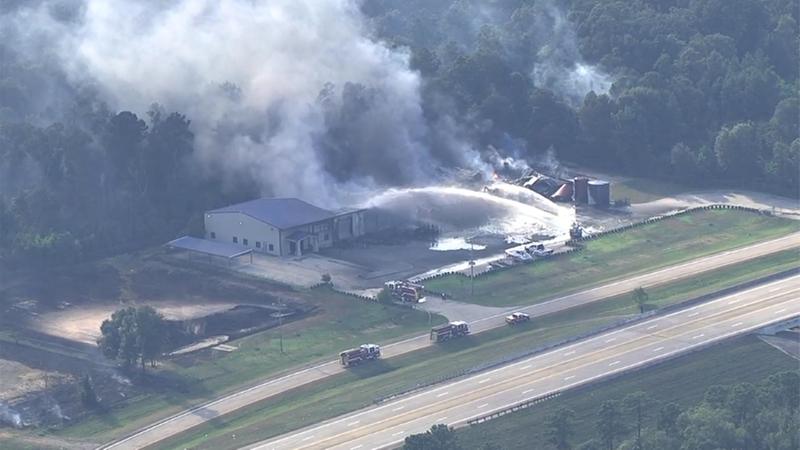
Friday afternoon there was a fire at a chemical facility in Conroe, TX. The facility was a supplier of drilling chemicals for the oil field. Interesting news accounts here, here, here, here and here.

Background

There are a wide variety of chemicals used by the crude oil drilling industry. Many of the products used contain flammable solvents; including toluene, xylene, methanol and acetic acid. The first two are not soluble in water and typically float on water. The second two are water soluble and in fairly low concentrations make water flammable. Applying water to fires involving any of these chemicals has a tendency to spread the fire, not put it out.

Oil field drilling chemicals are typically shipped to the field in containers; 5-gal pails, 55-gal drums, and 250-gal plastic totebins. From the outside of the facility we cannot tell if this was strictly a warehouse of if blending operations happened in the facility. We can only see three relatively small storage tanks outside, but there may have been additional tankage inside of the building.

This facility was not specifically designed as a chemical warehouse or chemical manufacturing facility. According to Google Street Views as late as February 2013 it housed an insulation and fireplace supply company. As such it was originally designed to have a sprinkler system. From the progress of the fire (described below) that water based system may have been functioning on Friday.

The Figure below is a diagram that I drew of the facility based upon Google Maps. It is consistent with the photos shown in the various news stories about the fire. Bldg 1 was principally a warehouse with five loading docks facing the parking lot. The north end of Bldg 2 was also a warehouse facility with three loading docks. The south end of Bldg 2 was the facility office. There were roll-up doors from both buildings facing into the space between them with a ramp leading down to the parking lot level.


The Incident

From the news reports and accompanying photographs we can piece together much of what happened at this facility. A full investigation is underway and the initial cause of the fire is unknown.

At about 4:00 pm CDT the company closed up business for the weekend. The last employee left and the gates were locked. Apparently about 45 minutes later the fire started. Pictures (here) seem to indicate that the fire started in Bldg 1. By the time this picture was taken it is clear that there had been a release of one or more flammable liquids in the building and it had started to flow out of the building since you can see flames on the concrete parking lot.

There are a number of reports of explosions associated with this fire; with at least one being described as ‘large’. With fires in chemical warehouses it is very common to have containers ‘explode’. The heat of the fire causes the liquid to boil inside the container. The expanding gasses (even water vapor) in the container cause the container to catastrophically fail creating a small explosion. If the container contained a flammable or combustible liquid the expanding gas cloud would ignite providing a larger explosion. The relative sizes of the two explosions would depend on the volume of the container and the amount of solvent in the container.

A later picture shows the parking lot fully engaged in flames. Again this is a sure sign that there has been a major spill of a flammable liquid. Fortunately the parking lot was designed to keep any liquid on site and flowed into the drainage basin located on the south end of the facility. Aerial photos (here, here, and here) show that drainage basin on fire. From those photos it looks like the major fire in the parking lot was out by the time that the fire department arrived on the scene.

Pictures from the aftermath of the fire (here, here, and here) would indicate that Bldg 1 was a total loss, there is severe damage to the warehouse portion of Bldg 2 and there does not appear to be any significant off-site damage or runoff.

Probable Course of Fire

This was an unusual chemical warehouse fire. Fires that start in these facilities after hours typically involve electrical systems or non-chemical debris on site. For there to have been a significant chemical release early in the fire without a catastrophic explosion (the building was intact in early pictures) is very unusual. To get fire flowing into the parking lot there had to be a large amount of flammable liquid released; more than a drum or totebin’s worth.

I suspect that there was at least one storage tank inside the building containing a product with a fairly low concentration of flammable solvent (so that there wasn’t a large explosive vapor cloud). Somehow there was a failure of that tank that allowed the contents to start to drain onto the warehouse floor. At some point (either before or after that leak was initiated) a fire started igniting that liquid on the floor and the sprinkler system tripped applying water to the fire. The water from the sprinkler system spread the fire throughout the warehouse and out the door leading to the parking lot ramp.

The fire would have spread to wooden pallets holding drums or totebins of other combustible or flammable liquids in the warehouse. As those liquids started to heat there would have been a number of drums or totebins that would fail and some of those would have resulted in small fuel-air explosions as the volatile solvent vapors ignited.

The remaining liquid in those containers would have also been washed into the parking lot by the sprinkler system, contributing to the pool fire there.

At that point the warehouse would be fully involved and nothing would stop it from burning until all of the fuel (including chemicals that are normally rated as not being combustible) was consumed.

The large volume of fire in the parking lot was almost certainly caused by the failure of the small storage tank at the north end of Bldg 1. The smaller pool fire would have spread to near that tank. It looks like it was a plastic tank so that the fire caused the bottom of the tank to soften and release the contents. From the size of the resulting fire ball, I would assume that this was a solvent tank and resulted in a large fuel-air explosion described in the various news reports.

Commentary

Fortunately, this facility was designed with a system to catch rainwater and return that water to the aquafer via the drainage basin. This system was not specifically designed for catching chemical run-off from the facility as it is clearly visible in the pictures taken before the current occupant moved in. This allowed all of the burning runoff from the fire to be contained on site. The size of this fire would have been significantly larger if that system had not been in place. It will also make the clean-up of the aftermath of this much easier to accomplish.

It appears that the large pool fire in the parking lot was substantially over by the time that the fire department arrived. If fire trucks or personnel had been anywhere near that parking lot when it was fully engaged they would have been destroyed. Firefighters approaching a chemical facility fire really need to be aware of drainage patterns at the facility before they approach too closely.

Finally, facility owners and fire departments need to look at alternate routes of access to these types of facilities. In this case the wind was light and out of the east, blowing the smoke away from the only access to the facility. If the wind had been out of the north or worse yet, northwest, there would have been no way for firefighters to safely approach the fire.

Counter-Terrorism Notes

Now I don’t know exactly what products this facility contained, but I would suspect that this was not a facility that would have been required to report to DHS under the Chemical Facility Anti-Terrorism Standards (CFATS). That means that it is not really fair to discuss site security measures for the facility. The facility did have a perimeter fence and locked gates, much the same as you would see at most industrial facilities across this country.

Having said that, this fire would have been fairly easy to have started as part of a terrorist attack. Approaching through the woods behind the facility, a lone attacker with some small explosive devices could have started a nearly identical fire by putting those small charge on a number of different totebins containing flammable chemicals scattered around the warehouse.


A small fairly isolated facility like this would not be a typical target form Islamic militants or radical militia members, but an environmental wacko (no, not an environmental activist, but a real fringe nut case) would find a company associated with supplying the crude oil drilling industry a prime target.

Saturday, June 13, 2015

EO 13650 Updates

As part of their ongoing efforts to comply with the President’s executive order on chemical safety and security (EO 13650) OSHA has updated their EO 13650 web site. The new information includes links to three new documents:


Additionally, there is an announcement of a webinar to be conducted by the Chemical Safety and Security Working Group. The webinar will be conducted on June 19th. The site provides an email address (eo.chemical@hq.dhs.gov) to sign up to participate in the webinar.

Friday, June 12, 2015

CSB Land Use Study RFI

Yesterday the Chemical Safety and Hazard Investigation Board (CSB) posted a request for information to the FedBizOps.Gov web site to support a possible solicitation for a study about land use patterns around high-risk chemical facilities. The CSB is planning on conducting a study related to the proximity of community buildings to the fence line of facilities handling flammable, explosive or toxic chemicals.

The study would focus on four major topics:

• Review and evaluate how the proximity of facilities handling hazardous chemicals can pose a risk to communities across U.S. as a result of fires, explosions and chemical releases resulting in health or environmental effects.

• Identify approach(es) that could be used to determine appropriate distances between communities and hazardous facilities, accounting for chemical toxicity, flammability, and explosion potential and blast overpressure.

• Review current regulations, including state and local ordinances and recommended practices related to land use and development in close proximity to existing chemical facilities, as well as the siting of new chemical facilities and determine whether existing requirements and practices are adequate in their degree of alignment with the technical analysis from Tasks 1 and 2.

• Identify the appropriate regulatory bodies and make regulatory policy recommendations or other recommendations as appropriate based on findings from the analysis from the tasks described above.

This RFI seeks information about organizations that might be interested in conducting this type of study. It is not a solicitation to perform the study. Part of the purpose of the RFI is to determine if there are small businesses that might be interested since the CSB may be able to source this study under a small business set-aside program.


Interested parties should submit the requested information by June 19th, 2015.

Tuesday, February 18, 2014

EO13650 and IST: A Look Back at Proposed Solutions

There has been an interesting undercurrent in the EO 13650 Working Group about the inevitable discussions about inherently safer technology that have come up in the public listening sessions being held by the Working Group. The environmental and worker’s rights advocates are predictably pushing EPA, OSHA and DHS to adopt some form of IST mandate as a way to reduce the hazards from accidental or deliberate releases of industrial chemicals. Just as obviously, industry groups continue their adamant stance against any such proposal.

The regulators that sit on the dais at these listening sessions, acting as the ears of the agencies, are placed in an unenviable position. Some level of IST commitment is almost certainly going to come out of this process as a proposal for regulations, but the regulatory community is not going to get any additional manpower or funding for implementing such a regulation because this is an Executive Order, not Congressional authorization.

Complicated Topic

All sides of the disagreement do acknowledge that inherently safer technology techniques do offer a way to reduce the hazards associated with dangerous chemicals. The two sides, however, vehemently disagree on how such a program should be implemented or how much of a role the government should have in such an implementation.

Unfortunately, neither side really listens to (or even trusts) the other side. As with most complex problems this is not a black/white issue that can be resolved by simple means. Over the last six+ years writing this blog, I have taken a hard look at the IST issue and have offered suggestions on how to effectively deal with many of the issues involved.

I have a great deal of self-confidence and think rather highly of my ideas, but I know that I am not the source of all knowledge. But I have tried to look at IST from the point of view of a professional in the chemical manufacturing industry who has spent many years making things work. Some of the ideas that I have written about could be used to form the basis of a workable IST regulatory scheme.

IST ISSUES Page

I have just put up a new page on this site that compiles a list of the IST posts that I have written over the last six years. They are not indexed; they are just listed chronologically. I have added a listing of the sub-headings from those posts (or at least the ones with such sub-headings) to give people some insight as to what is being discussed.

There are a couple of specific series of blog posts that I would like to call special attention to because they do an in-depth look at various aspects of a practical IST regulatory system. I will list the last post in these two series here as those posts will provide links to the earlier posts in the series. Those two series were:


Formatting Issues


I do have to apologize for the readability of some of those earlier posts. In transferring posts from the original site on AOL Communities to Google, much of the formatting disappeared. From time to time I do go back and re-edit the formatting of some of those earlier posts to make them more readable. That is a time consuming (and very boring process) so some of those posts can be more challenging to read than others. I will give priority to fixing these IST posts over some of the others, but it will still take time.

Tuesday, February 4, 2014

Alternative to S 1961 – Why so few tanks?

When I wrote my blog post this weekend proposing an alternative to S 1961, Sen. Manchin’s (D,WV) chemical storage bill, I greatly reduced the number of storage tanks that would be covered by the legislation. As an industrial chemist, I wish that I could tell you that I reduced the number because I know that the vast majority of the storage tanks that Manchin’s bill would have had inspected did not need to be inspected because the chance of their leaking was remote. Unfortunately, I can’t say that; I just don’t know.

If I don’t know that the tanks that will remain uninspected are safe from leaking, how can I remove them from the list of tanks to be inspected? The answer is painfully simple, even if Manchin’s bill became law today, the vast majority of the chemical tanks covered would remain uninspected for decades to come. And a significant percentage of those that passed inspection would leak before they were next scheduled for inspection.

What Could be Covered?

To see how I can say that, let’s take a practical look at the sweeping storage tank inspection requirements in Manchin’s bill. First off, the bill never mentions storage tanks; it discusses covered chemical storage facilities. It describes chemical storage facilities as “a facility at which a chemical is stored” {§1471(1)(A)}. It doesn’t describe what chemical, or how much chemical or in what types of containers it is stored.

The only limiting factor to a covered chemical storage facility would be the determination by a State water treatment regulating authority “that a release of the chemical from the facility poses a risk of harm to a public water system”. Again there is no limitation of the type of risk or the level of risk; just that it would pose a risk of harm and again ‘harm’ is undefined.

The bill intends for the widest possible latitude to be taken in determining which chemical storage facilities are covered. This can be seen in the language for the inspection requirements for those facilities in §1472(b)(2)(B). It provides for inspections to be taken for facilities within the State source water assessment area as defined in 42 USC §300j-13 and less frequently for those facilities outside of the source water assessment area.

Section 300j-13 describes the source water assessment area as those areas “in such State from which one or more public water systems in the State receive supplies of drinking water, using all reasonably available hydrogeologic information on the sources of the supply of drinking water in the State and the water flow, recharge, and discharge”. Areas not in the source water assessment area would then be all other areas of the State. From this we can see that the Manchin bill does not even require that the potential harm from the chemical has to deal with contaminating the source water for a treatment plant.

In essence, every chemical storage facility in the plant could be a covered chemical storage facility depending on the whim of the State regulator. Because there are no limits on the types or quantities of chemicals involved, every facility in the State could be determined to be a covered chemical storage facility because every facility in the world that stores anything, by definition stores chemicals.

What Would be Covered?

Okay, let’s assume that these political authorities are going to be reasonable (what lawyers describe as ‘a fact not in evidence’) and for the sake of argument assume that they are only regulate facilities with storage tanks. After the problems seen in Charleston, WV with a relatively small leak (less than a ¼ of the tank contents over a period of hours) from a tank containing a relatively non-hazardous chemical (not on any government list of hazardous chemicals), I think that we can assume that any politician in his right mind (okay, that may be a contradiction in terms) is going to assume that any chemical in a tank over a minimal size (say 1000 gallons) is going to qualify the facility as one that might harm a water treatment facility.

And I think that if you were to ask Sen. Manchin or almost any resident of the environs affected by the water system issues in the Charleston, WV area that they would almost unanimously agree with that being the intended scope of this bill. So, how big is that scope; how many facilities are we talking about? Sad to say, nobody knows.

Let’s take a look at the initial coverage of the CFATS bill by comparison. That bill defined the hazard as being related to a minimum quantity of no more than 300 chemicals. For the sake of argument, let’s assume that each of the chemical facilities that filed an initial Top Screen for the CFATS program had at least one storage tank on site. There were over 40,000 such facilities in the United States in January of 2008 when the initial Top Screens were filed. That was 40,000 chemical facilities and all of the facilities at US ports were exempted, all military bases were exempted, all water treatment and waste water treatment plants were exempted and only 300 chemicals were considered.

The covered facilities under the Manchin bill would be much more sweeping in its coverage and scope and no facilities are exempt from the requirements of this bill. There has got to be hundreds of thousands of facilities in the United States that have storage tanks on site. Just think of how many gas stations there are. We could easily be looking at more than a million covered chemical storage facilities.

How Many Inspectors is it Going to Take?

Every time that there is a newsworthy accident at a chemical facility, one of the first thing that reporters dig up is the length of time since the offending facility was last inspected by OSHA or the EPA, or DHS. In almost every case the time has been excessive by the reporter’s standards (and, to be fair, excessive in the minds of most of the public). The reason for the inspection gaps is not malfeasance or graft, it is simply that there is an incredibly small number of inspectors to cover a huge number of facilities.

Right now there are zero inspectors available to water treatment regulators in the States to conduct storage tank inspections. So each State is going to have to stand up a new chemical tank inspection force to implement the requirement of Manchin’s bill. Say that there are 50,000 facilities (and that is way on the low side of what I expect there to be) in a state that will require inspections every 4 years (half at three years and half at 5 years). That is 12,500 inspections a year. If each inspector can inspect one facility a day, 5 days a week, 52 weeks a year (an extremely aggressive inspection program) it will take about 46 new inspectors, five new supervisors, a program director and a support staff to meet these new program objectives. There will have to be office space, computers, printers, cell phones and state vehicles to support the program.

And all of this is going to cost a great deal of money. And who is going to pay that money, the tax payers of course. Oops, not likely. Let’s cut that back to a program that the Governor can budget for.

What will the program actually get? Six inspectors and a supervisor; forget the support staff, they can do it themselves. We will give then three cars because they are only going to get out of the office two days a week because they are doing their own report writing and filing; so they can share vehicles. They will do three inspections on each of those two days; it will be quick, but how hard can it be to inspect a bunch of storage tanks? They will be active 48 weeks a year (you can’t forget mandatory training and conferences) so they will actually inspect 1,728 facilities a year and it will be 28 years before they get the first round of inspections done. If management is smart, they’ll inspect the facilities upstream of the water treatment plants first; BIG IF.

You Can’t Inspect Everything

It is a sad fact of regulatory life, you are not going to get a chance to inspect everything; the taxpayers are not going to stand for it. So you have a choice, you can pretend that you are going to inspect everything and most people will consider the program to be a joke. The owners who care will already have been making an effort to things right. The ones that don’t care won’t change until they get a violation notice and even then a number of them will gamble that you won’t be back to verify that they fixed stuff.


Or you can try to define the program so that is limited enough in scope that you can inspect everything that is really important to inspect. If you are talking about protecting drinking water, then you inspect those facilities that have chemicals that the treatment facility cannot remove from the water. And you only inspect those that are close enough to provide an imminent danger in the event of a significant leak.

Saturday, January 18, 2014

Chemical Spill Prevention Legislation

It took over a week for a set of legislators to come up with a knee jerk reaction to the chemical spill and water system closure incident in Charleston, WV. Normally I wait for actual legislation to be published before commenting on it, but because of the publicity already being generated by this bill that can’t actually be introduced until the 27th I think that it is fair game.

The trio of Senators, Manchin (D,WV), Rockefeller (D,WV) and Boxer (D,CA) have crafted legislation that they claim “will help protect Americans from chemical spills that threaten drinking water”. This is certainly a laudable intention and the two West Virginia legislators certainly have a strong political reason for responding to the Freedom spill in a timely manner.

Their press release indicates that the bill embraces four key principles:

1. Requiring regular state inspections of above-ground chemical storage facilities,
2. Requiring industry to develop state-approved emergency response plans that meet at least minimum guidelines established in this bill,
3. Allowing states to recoup costs incurred from responding to emergencies, and
4. Ensuring drinking water systems have the tools and information to respond to emergencies.

It is hard to argue with these principles as they all appear on their face to be reasonable responses to the latest chemical incident. While the devil is always in the details, and we won’t know those for at least a week (unless the Senators are willing to release at least a draft copy of their bill), there are some obvious pitfalls in putting these principles into regulatory practice.

State Inspections

The federal government usually gets into problems when it starts to tell the States what to do. We already have State enforcement of many of the federal chemical safety programs and the drinking water programs managed under the EPA are almost all enforced by State regulators. The reason for this is clear, no one in Congress wants to be responsible for paying for the huge number of inspectors and other regulatory staff that would be responsible for federal oversight of these regulations.

There is much to be said in favor of State enforcement over federal enforcement of environmental regulations. Local conditions will have a huge effect on what is important. The air pollution controls necessary in an overcrowded and physically confined space like the Los Angeles basin are completely different than those that would apply in Alaska. The surface water protection requirements for Florida will be much more extensive than those in Arizona. And the chemical storage safety requirements will be much more stringent along the Houston ship channel than on a Kansas wheat farm.

But, there is also a completely different political climate in each of the States that will affect how well the State can or will implement chemical safety requirements. One only has to look at the proactive chemical safety program in Contra Costa County, California and compare it to the much more hands-off approach of the Texas state programs. Those local responses are governed by the opinions and political activism of the local population. And that local population, through their elected representative, will govern how much money these various State agencies will be able to spend to implement a chemical safety program.

Emergency Response Plans

I have long advocated more extensive emergency planning requirements for chemical facilities. The current lack of standards ensures that the vast number of existing emergency response plans are inadequate at best, and mostly non-existent. The establishment for standards, provisions for training local planning organizations, and funding for the development and periodic exercising of emergency response plans is an absolute must for the most dangerous chemical storage facilities.

While the owners of chemical storage facilities have a critical part to play in any emergency planning process, they cannot be held responsible for the process. The vast bulk of the response effort in the event of an accidental or deliberate chemical release will fall on State and local response agencies. Those agencies cannot allow local industries to mandate what their actions will be in a chemical release scenario any more than local police departments can allow banks to dictate how they will respond to a bank robbery.

Industry can only (and absolutely should be) held responsible for the on-site response efforts and the prompt complete off-site notification of all chemical incidents that could potentially have consequences beyond the local fence line.

They clearly should have a role in the State and local emergency planning process. Information about the type, quantity and location of potentially hazardous chemicals can only come from facility owner-operators. The facility should also have more expertise in handling and exposure issues related to those chemicals. But, legislators are going to have to be extremely careful about how they establish requirements for the facility support of the emergency planning process. If they get too aggressive, they are going to drive many small businesses out of business.

Cost Recovery

The idea that State and local governments should be able to recover their emergency response costs is certainly a good idea. I’m sure that there are many provisions in current civil law that allow for such recovery actions. The big problem is that the civil actions that result from incidents like the Freedom spill or the West explosion quickly bankrupt small companies that are involved in such incidents. Adding State and local governments to that civil liability chain will only drive companies to bankruptcy faster and ensure that private citizens recover an even smaller part of their just injury compensation.

Drinking Water Protection

We all certainly need to be concerned that drinking water systems have the tools and information necessary to ensure that our drinking water is safe (a topic I discussed here). Having said that; we need to be extremely careful that we don’t try to make the local water treatment facility into something which it is not. There is no way that any water treatment facility is going to be able to afford the equipment and personnel required to be able to remove all potential contaminants from water. Nor is the local water company laboratory going to be able to detect all of the possible contaminants that could be found in the water. The local taxpayers will not, cannot, afford to fund a facility with capabilities of that scope.

The only reasonable way to design a local water treatment facility is to look at the water supply and its normal seasonable variations to determine what contaminants are typically found in that supply. The water treatment methodology must be designed to remove those contaminants down to well understood and quantified safe drinking levels. Inlet water testing must be able to confirm the variations in the concentration of those normal contaminants that would affect processing conditions. It must also be able to routinely detect the most dangerous chemicals that could possibly be found in the water supply, particularly those that would not be removed to safe levels by the routine water treatment process employed at that facility.

I do believe that a water treatment facility should have test methods available to detect all chemicals routinely stored in bulk upstream (for a reasonable distance) of any surface water intake. There should be periodic water testing done with those methods, mainly to ensure that the laboratory maintains their ability to conduct those tests. In the event of an upstream spill this would allow the facility to begin routine testing to detect the arrival of that material upstream of the intake far enough to allow the facility to take appropriate action before the material gets into the facility.

That would also demand that the facility operators have a clear understanding of what contaminants that their operating system is not capable of removing to safe levels. This also demands that safe levels are known. Any chemical which is not removed by the treatment system, or for which there is no safe level established, should not be allowed to enter the treatment facility.

Scope of the Problem

The one thing that the press release and provided fact sheet clearly do not address is the potential scope of the problem. Depending on how they define chemical storage facilities this could include hundreds of thousands of facilities. The initial CFATS top screen submissions came from over 40,000 facilities that only stored large quantities of a little more than 300 chemicals that might be the target of terrorist attack. 

The number of inspectors that is going to be required to visit each and every one of those facilities on a routine basis is going to be huge. It might be large enough to have a noticeable impact on unemployment numbers if there were qualified people available to fill the positions. The funding that is going to be required to staff and support those positions will be enormous.

The amount of time and effort necessary to develop the emergency response plans for all of those facilities is going to task local first response agencies that are already having problems funding actual responders. The Local Emergency Planning Committees are already tasked to complete these efforts but are not funded and are generally ineffective. Adding requirements to their plans by requiring specific drinking water protection plans will not make them more effective.

Wait and See

Again, I haven’t seen this proposed bill (and I am not sure that it is yet in its final introduction form), but I would be very surprised if the bill takes into account the limitations that I have discussed above. A rapid political response, such as this bill, to an incident is almost always ineffective at achieving its objectives and always produces unintended consequences.

The chemical industry is certainly going to oppose legislation that expands the scope of current regulations. Having said that though, Lawrence Sloan, the President of SOCMA made a very important point in a blog post on Friday; “What we need is greater accountability and adherence to existing regulations throughout the entire chemical supply chain.”


It would be more effective in the long run if legislation waited until the Chemical Safety Board completed their investigation and made their recommendations. But, Senators Manchin and Rockefeller had to have something in hand this week as they head back to West Virginia to talk to voters and supporters.
 
/* Use this with templates/template-twocol.html */