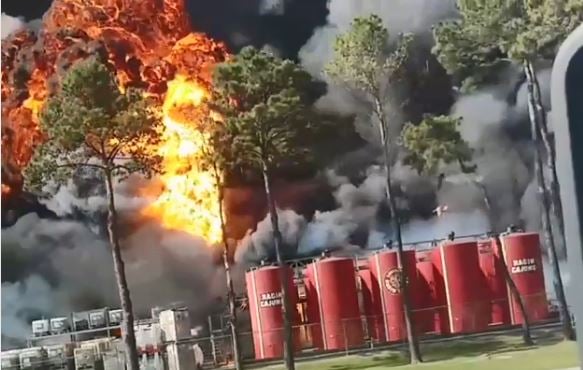
Earlier this week there was a significant fire at a chemical
facility in Duson, LA (according to the company web site the
location is actually in Rayne, LA, but the news reports are consistent in
calling it Duson). The facility appears to be a distribution center for the
company’s oil field chemicals, though some blending may take place in at least
one of the buildings on site.
The News Reports
News reports (here,
here,
here,
and here)
would seem to indicate that the fire started with an initial explosion, followed
by a number (one witness reported
“dozens of explosions in a half hour to one-hour period”). These reports,
combined with a news
photo of the incident (which shows the 10 storage tanks on site intact
during the active phase of the fire) would indicate that the fire took place in
the open storage of chemical containers (55-gal drums, plastic and steel
totebins).
A company statement quoted here
notes that “there are no uncontained spills”.
Google satellite
view shows that a large portion of the facility is given over to open
storage of chemical containers. Google street
view of that storage area shows that it consists of a concrete pad
surrounded by a 6” to 8” curb to contain spills. Street
view from the back side of the plant shows that the ‘tank farm’ containing
10 storage tanks (4k-gallons each?) is on the same pad but is surrounded by an
additional 8” to 10” curb.
The chemicals reported on site reported include a wide
variety of oil field chemicals. Many of these chemicals would have flammability
and corrosivity hazards associated with them. A close look at the Street View
of the storage tanks shows that at least two of them contained flammable
materials. The flammability of the typical oil field chemicals is due to the
solvents used, which typically would include xylenes, methanol, toluene and
benzenes.
Analysis
The investigation of this fire is ongoing and is being
conducted by Louisiana authorities (the CSB typically does not investigate
incidents that do not include deaths, wide scale damage, or national news
focus). The results of that investigation will not be available for weeks and
will probably escape news coverage unless some unusual (read ‘chargeable’)
aspects are uncovered.
Based upon news storied I suspect that there was a leak in
one of the storage containers on the concrete pad that contained a flammable
liquid. Some sort of ignition source (static discharge?) ignited the small pool
of spilled chemicals. The initial explosion reported was probably a vapor cloud
near the initial fire and probably from the same spill. That small explosion
would have damaged nearby containers, contributing to the spread of the fire.
The subsequent reported explosions were probably
attributable to nearby containers containing flammable/combustible chemicals being
heated to the extent that the gasses expanded in the container until the
container was no longer able to contain the pressure. As flammable gasses exited
the damaged containers, they were ignited by either the nearby fire or static
discharges associated with their release.
At first glance the ‘containment’ at this facility would
appear to be rather proforma. The saving grace is that the very large area encompassed
by the relatively small curb results in a substantial volume of containment. I
have not done the calculations, but it would seem that a large percentage of
the containers on site could leak their full contents and the liquid would
still be physically contained. Even if one of the storage tanks were to
completely drain, it would appear unlikely that any of the contents would flow
off site.
This would meet all of the legal standards for containment.
The only problem would occur if the leak occurred when there was a large amount
of water on site, either due to rainstorms (for which Louisiana is famous) or
the application of large amounts of firefighting water. From the news reports
that I have seen, it would seem that the local firefighting response did not
use large volumes of water; it is usually contraindicated in flammable chemical
fires in any case.
The combination of water-soluble (methanol) and water-insoluble
(benzene-based chemicals) flammable chemicals on site would cause potential
problems with the use of foam for firefighting as they require different types
of foam to be used. Still, most fire departments are not going to have access
to either type of foam. The best bet in that case is to isolate the facility
and stop the fire from moving off-site.
This fire would have been more serious if one of the storage
tanks had been a source of the leak that initiated the fire. A fire at the base
of one of the tanks could have resulted in a weakening of the tank wall, a
resulting collapse and release of the entire contents. The resulting fire and
potential vapor cloud explosion would have damaged adjacent tanks spreading the
fire throughout the concrete pad area. The overpressure resulting from the
larger vapor cloud explosion would also probably have resulted in off-site
damage (broken windows and flying debris).
One final note; as is usual with any incident at an
industrial facility, at least one
news report went back and looked at the regulatory history of the facility
involved. They reported on the problems this facility had with the EPA’s hazardous
waste regulations. While this is certainly part of the public record, these
paperwork violations have little to do with chemical safety and certainly nothing
to do with the current incident.


 Posts
Posts